The bitGAN Act 1 Puzzle: a briefing for GPT-6 Astra
Prepared 2026-09-09, revised 2026-09-14, by the puzzle team for a fresh solver. Everything you need is public. This document tells you what the puzzle is, what has been tried, where every resource lives, how to use our website and data, and what kind of thinking we want from you.
Read this before anything else: how we think, and how we test.
- No brute force without a theory. Nothing runs against the wallet until three rules are written in plain English, each one Pindar could have stated in a sentence: which pieces are the glitches and why exactly those; how each piece becomes one seed word, by one rule applied the same way to every piece; and how the words line up, with mint order as the default because both of Pindar's solved puzzles used it. Enumerate the free choices inside an agreed hypothesis as much as you like. Never assemble eleven seed words from mixed rules and try orders. A set earns attention by its motivation, not by landing on eleven; about 73 trait combinations do that by chance. Repeats are allowed.
- The phrase may be shorter than eleven glitches. Pindar's anchor pieces sit outside the numbered run: #0, the Pandimensional skullGAN (essence "universe", Dimensions "infinite"), and #512, the Quantum glitchGAN (essence "final", the only Dimension-11 piece). A hypothesis may be nine or ten glitch pieces with #0 and #512 as bookends, or ten with one bookend, and should say so. The Solstice puzzle pinned its ends the same way. Bookend variants were swept on the essence register only (Part 5); the shape is open.
- Be creative, in Pindar's register. He said everyone had been "looking for glitches all wrong". The interesting finds are lessons as much as containers: a corrupted label may teach a move (reverse it, cut the suffix, read the other column) meant to be applied somewhere else. When you find something odd, ask what it teaches before asking what it contains. The vanilla readings of the obvious fields have been exhausted on every principled set.
- Check us, do not trust us. Every fact in Part 4 and every result in Part 5 came through our hands. Re-derive what matters to your theory from the primary sources in Part 3.
Read Parts 1 to 4 before touching data. Part 5 lists what we tried and what happened; nothing in it is declared closed. Part 6 shares the ideas we found most promising. Follow your own path and your own theories; we only want you to have everything we did in front of you.
Part 1. The puzzle in one page
The prize. A 12-word BIP-39 seed phrase opens an Ethereum wallet at 0x18f87ec9c527aba1db44f715456bf28b0dae478d. The wallet holds the prize. Anyone who recovers the phrase can take it.
The clue. The artist Pindar Van Arman posted one sentence on 5 February 2022, on the page titled "The Act 1 Puzzle" at bitgans.com/news/cryptoartgans:
"The seed phrase is 11 glitches ending with a random word."
A BIP-39 phrase has 12 words. The clue says eleven of them come from "glitches" and the twelfth is random. Because the twelfth word is random, a solver only needs the eleven words and their order. The twelfth word is then one of 128 checksum-legal candidates, which a computer can try in seconds.
The collection. bitGANs are 512 animated pixel-art GIFs, 32 by 32 pixels, minted on the OpenSea Shared Storefront contract (0x495f947276749Ce646f68AC8c248420045cb7b5e). Piece #0 (the Pandimensional skullGAN) is a separate one-of-one on SuperRare and sits outside the 512. Every piece carries metadata traits: GANg (the species, like skullGAN), Type, SubType, Eyes, Dimensions, and an Essence, which is always a word. Pindar confirmed the puzzle spans all 512 pieces, not only the final drop.
The 512 arrived in six drops. Each drop numbers its pieces in its own way, and that matters:
| drop | pieces | count | how the piece's own name counts it |
|---|---|---|---|
| skullGANs | #1 to #128 | 128 | decimal, "(n/128)", 1-indexed |
| roboGANs | #129 to #192 | 64 | six-digit binary in the name, "(010011)", 0-indexed |
| spookyGANs | #193 to #208 | 16 | octal, "(0o3)", 0-indexed |
| Solstice | #209 to #300 | 92 | absolute number, "(#224)" |
| ghostGANs | #301 to #444 | 144 | decimal, "(n/144)" |
| Act 1 Review | #445 to #512 | 68 | absolute, "(n/512)" |
Skull, robo and spooky sizes are powers of two (128, 64, 16). Skull essences are the BIP-39 wordlist in order (piece #1 is "abandon", #2 "ability"). Robo essences were chosen by hand to match the piece (Firebot gets "fire", Dog God gets "dog"). Ghost, Solstice and Review essences are semantic.
Pindar's two solved seed puzzles set the precedent. He ran two earlier seed-phrase puzzles on other bitGAN sets and both were solved:
- In the roboGAN puzzle, the twelve words were the only BIP-39 words in the clue sentence, in mint order.
- In the Solstice puzzle, the words came from one property (dates and seasons), in mint order, with the ends pinned by the hint "It begins with sunrise and it ends with sunset." His own clue for that puzzle said: "Their essence is just a distraction, they hide their true BIP39 nature elsewhere."
- In the separate byteGAN puzzle, the key word was painted inside the art, and Pindar honored an unintended solving route: "it doesn't matter how you find the seedphrase and there is no judge."
So Pindar's method is mechanical and objective: one property or one visible thing, mint order. Nobody has to guess a word.
Everything Pindar has said about this puzzle (verbatim, our full record):
- "The seed phrase is 11 glitches ending with a random word." (the clue, 2022-02-05)
- "There are some glitch bitGANs with intentional errors - you will find others - they are glitched." (Discord, 2022-01-01, five weeks before the clue, replying to a collector who noticed a Rainbow skull, #58, missing its SubType)
- "…they have been looking for glitches all wrong." (X/Twitter, 2022-08-25, x.com/VanArman/status/1562799956175757313)
- "I just resolved the Glitch Puzzle. The back testing worked again... It was backtested and I can get into the wallet. But man I have to admit, even knowing how to solve it, it was hard." (Discord)
- "So don't feel bad for struggling with it. It's obviously a tough one." (Discord)
- "I can't give any more clues." (Discord)
- The puzzle spans all 512 pieces. (Pindar to the collector)
Quote 2 is the most important thing found this year. It confirms that deliberately wrong metadata is a glitch channel, and that there are several such pieces. Quote 3 says the community's idea of a glitch (a visibly glitching animation) was the wrong idea.
Part 2. What GPT-6 Astra can bring that we could not
We researched your capabilities before writing this. Sources: OpenAI's model page (developers.openai.com/api/docs/models/gpt-6-astra), OpenAI's announcement and safety overview, and coverage by MarkTechPost, DataCamp and others dated 3 September 2026. Corrections welcome if any of this is out of date.
What the specs say. GPT-6 Astra shipped on 3 September 2026 with a 1,050,000-token context window, 128,000-token maximum output, text and image input, and a knowledge cutoff of 30 April 2026. Through the API it supports web search, file search, code interpreter, a hosted shell, computer use, MCP, skills and tool search, with reasoning effort levels up to "xhigh" and "max". It scores 72.6% on OSWorld 2.0 for computer and browser use and is described by OpenAI as a computer-use system rather than a chat model. Requests over 272,000 input tokens are billed at higher rates.
Why that matters here. Our previous work was done by Claude models in a coding harness with a human collector adjudicating visuals. Four constraints shaped what we could do:
- We never held the whole problem in one context. Our data is about 35 MB. Your context can hold the full spreadsheet, the on-chain traits, the decisions log, the anomaly ledger and the complete list of dead word-sets at once, and reason across them without paging. Do that. Most of our misses came from not seeing two facts side by side.
- Visual work went through a bottleneck. Every visual judgement had to be staged as a frame grid for the collector's eye, one question at a time. You can take images directly. All 512 GIFs are public at full resolution (about 5 MB each) plus a mid-frame thumbnail for each. You can render every frame of every animation yourself with the code interpreter and look at them in bulk. Nobody has yet looked at all 22,000 frames with a strong vision model and a steady standard.
- We could not browse Pindar's world freely. You can drive a browser: read every journal page at bitgans.com, walk the Arweave archive, read the OpenSea token pages and the contract on Etherscan, and mine the bitGANs Discord if your operator gives you access. The single biggest find of the project (quote 2 above) came from a human scrolling old Discord messages. There is almost certainly more there.
- Independent verification. You can re-derive any claim in Part 4 from primary sources with your own code, in your own environment, rather than trusting our files. Do that whenever one of our claims matters to a theory of yours.
One practical constraint. Deriving one Ethereum address from a candidate phrase costs about 1.4 milliseconds of PBKDF2 work. The full space of 11 words in every order is 11! = 39,916,800 orderings times 128 twelfth words, roughly nine core-days per word set. Brute force over orderings is expensive, so in practice the words and their order have to come from a rule, as they did in Pindar's two solved puzzles. If you have far more compute than we did, that changes what is practical.
Part 3. Where everything lives
3a. Pindar's primary sources
| resource | where | what it is |
|---|---|---|
| The clue page | bitgans.com/news/cryptoartgans | "The Act 1 Puzzle", 5 Feb 2022. Only the clue sentence is bolded. |
| The hidden journal | bitgans.com/journal | 19 entries. Page 002 "Hidden Types" (31 Aug 2021) defines the HiddenType letters. Pages 003 to 007 explain Fibonacci, prime, square, odd and even skullGANs. Page 008 explains forging. Page 013 "Seasonal Patterns". Page 014 "BIP39 and bitGANs" and page 015 "bitGANs on arweave" are both dated 1 Jan 2022, the same day as quote 2. Page 016 "Act 1 Finale" (7 Feb 2022) lists the Act 1 roster. Page 018 "Hidden Lore Revealed". |
| Hidden types news post | bitgans.com/news/hidden-types | Defines a "fibonacci-glitch" as "every frame not part of the fibonacci sequence is inverted." We tested this literally against the shipped GIFs and it does not hold; it described a pre-release animation. |
| Solstice solution | bitgans.com/news/pattern-revealed | How the Solstice seed puzzle was solved. Read this first for Pindar's style. |
| Lore | bitgans.com/news/pandimensional-skullgan-ch2 and bitgans.com/news/the-final-bitgan-drop | Chapter 2 says "a select few would be Named… these Named bitGANs would be the key to unlocking the full story." 38 pieces carry a Name trait. |
| The Arweave properties sheet | arweave.net/UwiYOGcO2pp-uRcyLnFxgYeSAwBzKSl91Nzz_wpypuw | Pindar's own CSV of all 512 (plus #0). Columns: Number, Title, Name, GANg, SubType, Type, Eyes, Dimensions, Essence, Drop, Level. A copy is in our data bundle as arweave_bitgan_properties.csv. |
| The Arweave GIFs | Pindar's ArDrive, drive id cbbca83e-8cf4-44c0-b193-f886f1352cb6 (folders bitgans_on_arweave, bitgans_ghostsinthemachine, bitgans_act1review, noungans; drop archives 01_skullgans.zip to 06_act1review.zip) | The original files. On 13 Sep 2026 we downloaded every archive and loose file and hashed them: all 512 GIFs and the properties sheet are byte-identical to our copies (ar_zips.json, arweave_filenames.json). arweave.net times out on the archives and ar-io.dev wants payment; arweave.fllstck.dev and permagate.io serve them in ranged chunks. |
| The contract | Etherscan, 0x495f947276749Ce646f68AC8c248420045cb7b5e | OpenSea Shared Storefront. Token id = (creator address << 96) plus (mint index << 40) plus 1. Pindar's minting wallet begins 0x55372173. Mint indexes are in our token_index.json. |
| On-chain metadata | OpenSea token pages, or our chain_raw_by_mintindex.json | The on-chain traits differ from the Arweave sheet on a small number of pieces. Those differences are the confirmed glitch channel (Part 4). |
| Token transfer histories | Blockscout, https://eth.blockscout.com/api/v2/tokens/0x495f947276749Ce646f68AC8c248420045cb7b5e/instances/{token id}/transfers (no key needed) | Every transfer of every piece with timestamps. The storefront mints lazily, so the first transfer out of Pindar's wallet is the effective mint. Our pull of all 512 is transfers.json in the bundle. |
| The prize wallet | opensea.io/0x18f87ec9c527aba1db44f715456bf28b0dae478d | Check what it holds and whether it has ever moved. |
| The burn wallet | 0xa7c231c6e3de1bd3ca056e6303654f05e4ae1a0c | The Forge: 32 NFTs never transferred out, 30 of them bitGANs, 16 Flaming and 16 not, forming 16 completed forges. Pindar's own wallet burned six spookyGANs. |
| Pindar on X | x.com/VanArman | Quote 3 is at status 1562799956175757313. |
| Discord | the bitGANs server | Where quotes 2, 4, 5 and 6 come from. The 2022-01-01 exchange was with a user named Krum. We have not mined the server systematically. |
3b. Our website: bitganspuzzlebook.com
The site is the public record of five years of community work and eleven months of ours. It has seven tabs:
- The Puzzle. The clue, Pindar's quotes, the grammar of a recipe (select pieces, map, extract a word, transform, order), and the small set of literal values in the collection (painted numbers, the two boolean essences TRUE and FALSE, the one non-word essence "err0r", the anchor essences "seed" and "final").
- Collection. All 512 pieces with animations. Filter by tag. Click a piece for every trait, every recorded finding about it, and its partner if it is one of the eleven deliberate pairs.
- Glitches. The glitch classes and observations as concepts, each with a plain definition and its members.
- Extraction and Ordering. The 47 ways we know to turn a piece into a word, and the 33 ways to order eleven pieces, each with its tested status and what has been tried.
- Theories. 173 numbered theory cards. Each says how the pieces were picked, how it was tested, what happened, and a status (the site's labels are "ruled out", "near-miss", "open", "tested" and "retracted"; read "ruled out" as "we tried this and found nothing", not as a proof). Cards 141 to 173 are the recent structural work.
- Runs. The technical log of every sweep: label, result, number of orderings, and whether the planted control seed was recovered.
The API (read-only, JSON, at https://api.bitganspuzzlebook.com/api/...). It refuses requests with a default Python user agent, so use curl or set a browser-like User-Agent.
| endpoint | returns |
|---|---|
/api/stats | counts |
/api/pieces | all 512 with traits, drop, mint index, tags |
/api/pieces/{g} | one piece with every record about it |
/api/tags | the tag set with counts (drop, trait, glitch, observation) |
/api/concepts | glitch and observation concepts |
/api/principles | selections, extraction registers, orderings, with status, plain text, Pindar rationale, members |
/api/records | every per-piece finding (about 2,350) |
/api/hypotheses | the 173 theory cards |
/api/runs | the sweep log |
/api/intel | Pindar's quotes and links |
/api/search?q= | text search |
/api/export.csv | a flat CSV of the 512 |
Media. https://api.bitganspuzzlebook.com/media/gifs/{g}.gif is the full animation for piece g (1 to 512). https://api.bitganspuzzlebook.com/media/thumbs/{g}.png is a mid-frame still.
3c. Our data bundle: bitganspuzzlebook.com/data/
Fifty-nine files, about 35 MB, with an index at /data/ and a machine-readable manifest.json. The ones that matter most:
| file | what it is |
|---|---|
our_spreadsheet.csv and sheet.json | Our working spreadsheet: every trait from the chain and the sheet, mint index, burnt status, measured frame counts, visible creature, decoded hidden-type meaning, global number class, and more. |
deck_512.json | The same, wider: one record per piece with exact-case on-chain names, collector notes and derived columns. The master dataset. |
arweave_bitgan_properties.csv | Pindar's original sheet, unchanged. Compare against the chain to find the intentional errors. |
chain_raw_by_mintindex.json, onchain_meta.json | The on-chain traits for all 512 pieces, keyed by mint slot (token_index.json maps piece number to mint slot). |
DECISIONS.md | The rulings log, D1 to D47. Every decision the collector made and why, in date order. Read this after the theory cards. |
anomaly_ledger.json | About 2,350 per-piece records of everything ever found odd about a piece, with type, description and source. Append-only. |
glitch_dictionary.json and taxonomy.json | Every anomaly type with a definition and confidence, and how they fold into the site's concepts. |
methods.json and pb_content.json | The 24 selections, 47 registers and 33 orderings, with tested notes and plain-English prose. |
pairs.json | The eleven deliberate pairs with the reason for each. |
interpretation_matrix.json, instruction_schemes.json | Every reading of the corrupt eleven's error verbs as operations (169 readings). |
tested_sets_no_hit.txt | 146,474 eleven-word sets that we swept and found no hit. One sorted set per line. Each was tested only in the orderings its run stated, with 128 twelfth words and 33 derivation paths. Use it to see what has been covered; re-run anything you have reason to doubt. |
harness_sweeplib.py, harness_qbuild.py, harness_qrun2.py, bip39.txt | Our sweep harness. It tests each ordering against 128 checksum-legal twelfth words and 33 derivation paths (listed in sweeplib), and plants a known seed in every queue so a broken run is detected. |
michael_visual_notes.json | The collector's hand notes on all 512 pieces. His eye found things no detector did (colour flashes, painted numbers). |
HANDOFF-2026-08-28.md, SOLUTION_SPACE.md, FINDINGS-2026-08-31.md, TEACHING_RECIPES.md, BRAINSTORM_32.md, METHODS_RECIPES.md | The long-form working documents behind the theory cards. |
corrupt11_rows.html, glitch_verbs_by_logic.html, hiddentype_primer.html, creature_review.html | Self-contained visual explainers with embedded animations. Open them in a browser. |
burnt_gans_set.json, burn_all.json, forge_mapping.md | The Forge burns and pairings. |
token_index.json, arweave_file_txids.json, ardrive_meta.json, ar_zips.json, arweave_filenames.json | Mint indexes, Arweave transaction ids, the full ArDrive listing, and the hash of every archived file against ours. |
Part 4. What we know to be true
Each fact below is verifiable from primary sources. Part 7 asks you to verify them.
The HiddenType code is decoded. Skull, robo and spooky pieces carry an on-chain trait called HiddenType, a letter a to e or A to E. It is the piece's number class in its own drop's numbering, using the five classes Pindar defined in journal page 002 in a fixed order of precedence: a = Fibonacci, b = the remaining primes, c = squares, d = the remaining odd numbers, e = the remaining even numbers. Each number is filed once, so 2, 3, 5, 13 and 89 are Fibonacci rather than prime, 144 is Fibonacci rather than square, and 4, 16, 36 are squares rather than even. The order matters: b is the class that glitches and a is the protected set. Robots add F for the eight binary palindromes. The later drops carry no letter. Exactly five pieces wear the wrong letter, on purpose: #32 and #161 carry the literal text "32"; #119 is odd but filed as even; #187 is even but filed as square; #193, the first spooky piece, carries F, a class that exists only in the robo drop, where its position 0 should read A. Pindar flagged #32 and #119 in journal 002 as "typo or important?". We can now answer him. His own working sheet, pasted into the 1 January 2022 capture of journal page 015, publishes the HiddenType letter in plaintext for pieces 1 to 208, and it disagrees with the chain on exactly those two: it gives #32 the letter e and #119 the letter d, which are the correct classes for both numbers. So those two are errors on the chain that he had already fixed in his own data. The other three are identical in the chain and in his sheet: #161, #187 and #193 were carried forward deliberately. The five misfiles are two accidents and three intentions, and that split is evidence, not taste.
The prime rule. In the skull drop a piece glitches (in the frame-splice sense) exactly when its number is a prime that is not Fibonacci. The same rule holds for the robots on their binary position: 15 of 15 glitching robots sit at prime-not-Fibonacci positions, and the only clean primes are 2, 3 and 5, the Fibonacci primes. The Fibonacci positions are the protected, non-glitching set and coincide with Pindar's "Named" pieces.
The intentional metadata errors, confirmed by the artist. Pindar's sheet and the chain disagree on 29 pieces (recomputed 13 Sep 2026 on the complete chain pull of all 512 pieces). The disagreements come in kinds: two letters swapped ("Primoridal" on #16 and #100, "Gltich" on #73), a value written backwards ("wobniaR" on #48), something missing on one side (#58's SubType; the name suffix on #81, #97, #309; a letter on #88 "skulGAN", #123, #175; a space on #128; a plural s on #124; a stray backtick on #66), Type and SubType exchanged (#62), a different real word on each side (#17, #39, #44, #66, #173, #281, #509), a capital letter (#4 "SkullGAN", #383), a different number (#33, #290, #315), and a systematic rename (sheet "Twin" is chain "Twins" on all five). The community's earlier count of "exactly eleven chain-side corruptions" ({16,17,44,48,58,62,66,81,173,281,309}) was made on an incomplete chain pull; #4, #88, #97 and #100 also carry chain-side oddities of the same kinds. Which side is wrong is objective where the other side's value is the one every other piece uses, and a judgement (from title and art) where both values are real. The three Rainbows are the same value corrupted three ways. Every disagreement is on the site with both values shown.
The timeline around the clue, from Arweave and the chain. The four earlier drop archives went onto Arweave on 1 January 2022, the day of the Discord reply about intentional errors, and the same day as journal pages 014 and 015. On 31 January Pindar saved the properties sheet (19:42 UTC), uploaded it with the ghost and review archives (19:51), updated journal 015 with every link and archived that page (20:12). No GIF in those archives was edited after its Photoshop export, so the sheet is the artifact of that day, and its differences from the chain are what it put in: every skull-drop disagreement's chain record predates the sheet by five months. The ghost drop first left Pindar's wallet on 1 to 3 February; the prize piece #445 moved into the mystery wallet on 5 February at 11:12 UTC, the day the clue was posted; most of the Review drop, including all fourteen binary- and hex-numbered pieces and #512, first left his wallet on 24 to 28 August 2022, around his "looking for glitches all wrong" tweet. Every piece carries its first-transfer time on the site.
Which side is wrong, decided by three witnesses. For each of the 26 disagreements we asked whether the value is used anywhere else in the collection, what the Arweave filename Pindar wrote at export says (it sits in time between the chain record and the sheet), and what his journal says. Four piles: the sheet corrects a chain error on thirteen pieces (#4, #16, #48, #58, #62, #66, #73, #81, #88, #97, #100, #124, #309); the substituted word describes what the art shows on seven (#17, #39, #44, #66, #173, #281, #509, the collector's ruling by eye); the sheet introduces the error on three (#123, #128, #175); four number or capital differences are undecidable. Two candidate elevens fall out of the first pile: A, the skull pieces without #73; B, all thirteen without #73 and #66's stray backtick. Every piece on the site shows its verdict and the reasoning.
Pindar's filenames are his private construction code. Read from his Arweave archives for all 512 pieces: the "s_" prefix marks exactly the square-numbered skulls that take letter c (#121, eleven squared, is the one unmarked square); "smooth" marks only #5, #13 and #89, the Fibonacci primes the glitch rule protects; Primordial is written "ancient" eight times and "elder" once (on #16), both seed words where Primordial is not; solstice filenames carry "1221" and a season code tracking the Date trait the solved puzzle used; Review filenames group the drop into reprise00 to reprise13 (no reprise07) plus repriseaa, reprisebs, highdef, line, test, skullall and the tributes, and the fourteen binary/hex-numbered pieces are exactly the reprises of the robo, crypto and spooky pieces. All of it is tagged.
Rainbow is the demonstration word. It is the most-corrupted value in the collection (the three above plus #170 and #175, whose SubType reads "Raibow"). In the robo drop it becomes "Rainbot", the only truncated robot name stem, and "rain" is a BIP-39 word while "rainbow" is not. The first Rainbot, #134, has the essence "rain".
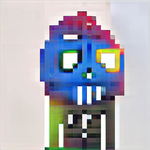
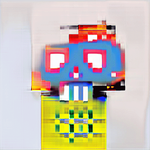
Eleven deliberate pairs. Two pieces carrying the same one-off defect that nothing else carries: {14,75} identical files; {479,480} held frame and one-off palette; {209,300} day and night (Solar and Lunar skullGANs); {489,491} scanline; {130,133} the same background flash; {165,207} painted numbers; {363,473} essences TRUE and FALSE; {16,100} both spell "Primoridal"; {175,205} both end "Gan"; {9,73} both filenames spell "gltich"; {170,175} both SubTypes spell "Raibow". Twenty-one pieces; #175 sits in two pairs.
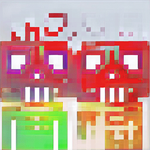


Other ratified glitch classes (ratified means the collector confirmed every member from all frames of the animation): the backwards-Fibonacci eleven, robots whose animation re-inserts a frame in a Fibonacci pattern {148,152,158,160,166,170,172,176,182,190,287}; thirteen Twins; fifteen Entangled pieces (the quantum thread across drops); eight palindrome nagaGANs; eight still-eyes pieces; four white-zero-eyes pieces; four negative-frame ("inverted") pieces {231,256,274,479}; six colour-flash pieces {130,133,462,463,464,497}; four painted marks (#165 "81", #207 "4", #179 "10.00", #379 "AI"). A held-frame detector calibrated on the collector's labels finds nine strong frame-hold glitchers in the whole set, and the seventeen skulls titled "Glitch" that do not visibly glitch are real (we call them glitch-name liars).
The Forge. Thirty bitGANs were burnt into 0xa7c2…1a0c as sixteen Flaming-plus-partner pairs. Exactly eleven of the burnt Flaming pieces are skullGANs, counting from the chain; counting from Pindar's sheet gives ten, because #66's SubType differs. #32 and #95 were burnt in the same transaction.
Two more complete sets. The BIP-39 list carries ten basic colour terms — black, blue, brown, gold, green, olive, orange, pink, silver, yellow — and every one is an essence exactly once. The list also holds bronze, copper, coral, cream, ivory, lemon, rose, salmon, sand and snow; of those, two are used, rose on #446 and bronze on #493. Robo essences are hand-picked. Skull essences are the wordlist in order with exactly two deviations, #21 "bean" and #57 "mistake".
The Solstice pair is a swap, not a displacement. We used to file #259, #260 and #268 together as "essences out of sequence". Pindar's own index column settles it: #259 carries index 181, which is the word *bird*, and #268 carries index 190, which is the word *bless*. The indices run in strict order through that stretch; only the two words changed places. Nothing left the run. #21 and #57 are genuine displacements; #259 and #268 are a transposition, and they are a different kind of thing.
Pindar published a wordlist index, and we only just found it. Piece #272 is the one piece whose on-chain description points at a different Arweave transaction from everybody else. Everyone else links to the 31 January 2022 capture of journal page 015, which is a short list of download links. #272 links to the 1 January capture of the same page, and that one has a 300-row properties table pasted into it. The table has four columns the published sheet does not: Decimal, Hidden Type, Strokes, and bip-0039, an explicit index into the BIP-39 wordlist, one number per piece. On every column the two versions share they agree exactly, so this is not an earlier draft that got corrected. It is the same data with his working columns still attached. #272 left his wallet on 4 January, three days after that capture, which is why it alone kept the older link.
What the index column shows. Taking his numbers for pieces 1 to 300 and reading the rest off the published essences, 510 of the 512 pieces map to a wordlist index, and no index is used twice. Indices 1 to 224 form one solid block, handed out in piece order: the skulls take 1 to 128, where the index is simply the piece number, and the Solstice drop carries straight on with 129 to 224. Six words are displaced out of that block, and exactly one index in it is held by nobody: 21, the word action. The displacements are: 57 alpha and 135 awkward and 191 blind and 195 blue all go to robots, 157 bean goes to skull #21, and skull #57 takes mistake from far outside the block. Two of the four robots that reach into the block are palindrome nagas, and Dr Awkward holds the word awkward. The spooky drop holds its own clean run, 800 to 815, glue through grape. The robo, ghost and Review drops are not runs at all. So the drops do not share one scheme, and the index column says where each of them sits.
The count of eleven is not evidence by itself. In a 512-piece collection with about fourteen trait dimensions, 73 different trait combinations produce exactly eleven pieces by chance. A set matters only when it is motivated by something other than its size. We learned this the hard way.
Part 5. What we tried, and what happened
The Theories tab carries the detail, card by card. Nothing here is closed. Every result below is "we tried this and found nothing", and any of them could hide a mistake in setup, data or assumption. Revalidate what matters to your own line of thinking; ignore the rest.
"Pick eleven pieces and read one word from each." For every ratified eleven, and for principled 9- and 10-piece sets padded with Pindar's anchor pieces (#0 "universe", #1 "abandon", #512 "final"), we read the essence, the piece number as a wordlist index, the mint number, the binary position, the title words, the SubType, the true-class word, the filename word, the visible creature and the painted marks, in mint, reverse mint, piece-number, alphabetical, drop-then-position, Arweave-upload, BIP-index and several composite orders. No hit. We also tried 49 candidate passphrases including "universe" and "infinite", and all 2,048 twelfth words at all twelve positions on the strongest sets. In total: tens of millions of derivations, 146,474 word sets, every run with a planted control seed that was recovered.
On the two candidate elevens (September 2026). Under the standing rule in Part 8 that nothing runs without a stated selection, word rule and order: the essence on every eleven inside the thirteen chain-error pieces and inside those plus the sheet-error pieces (151,164 orderings); "undo the error and cut the restored word to the list, repeats allowed"; and "the filename word as the unpublished column", each on A and B in mint and reverse-mint order. No hit. Three further readings could not fill eleven slots under their own rules and were not run: the hidden-type class names, applying each piece's own move to its word (the wordlist rewards reversal five times, an adjacent swap six, a dropped letter 198, but none of these words), and reading the sheet-introduced spellings as corrupted. Theory cards 175 to 181 carry the detail.
Letter tricks on words. Reversal, Atbash, Caesar, anagram and prefix-hop were tried as a family and found nothing.
Things we looked for and did not find. A "missing file" glitch class (all 512 files exist on Arweave; the gaps were in a local folder). A curated twelve. Systematic remakes or mirror images of earlier pieces in the Review drop (every frame compared with every earlier frame). A payload in #300's file bytes. The podGAN collection as a hidden layer. A montage-frame code. Any of these could be re-examined with better tools.
A working rule we adopted (D36). The collector asked that a word be objectively present on the piece: a metadata field, a mark painted in the art, or a creature anyone can see, rather than inferred from outside knowledge. This matches Pindar's "no judge" remark and his solved puzzles. We stopped pursuing artist-tribute, homage-target and lore-vocabulary word sources under this rule. You may weigh it differently.
Where our thinking ended up. After all of the above, we suspected that the seed is not distributed as one word per piece across eleven independently selected pieces, at least not through any register we could name. Either the words live in a channel we have not read, or the eleven glitches are eleven lessons rather than eleven containers. That is the thinking behind Part 6. Treat it as our current best guess, not a conclusion.
Part 6. The ideas worth your creativity
These are the ideas we found most promising. They are multi-step, they take Pindar's habits seriously, and each stalled at a specific place. We share them so you know what has been thought about, not as a list to work through. Follow your own reasoning; if it leads somewhere here, the notes below say how far we got.
6a. The glitches teach you how to solve it a different way
The corrupt eleven are confirmed by Pindar. We could not find their words in their metadata, their numbers, or the sets their true values name. Every attempt we made to read them as containers found nothing. One alternative is to read them as instructions.
Each corruption is a verb: reverse (wobniaR), transpose (Primoridal), delete (a missing field, a cut suffix), swap (Type and SubType exchanged), substitute (Rainbow became Flaming). The Rainbow trio shows the same word under three verbs, like a language lesson that conjugates one verb three ways. We tested the verbs as arithmetic on the piece's own numbers (its wordlist index, piece number, mint number, counted from 0 and 1) and found nothing. We tested undoing each corruption and following the true value as a pointer, and found nothing.
What remains untested is the reading where the verbs describe how the true words were hidden somewhere else, and the corrupt pieces are the key, not the lock. Questions we have not answered:
- If "reverse" is an instruction, what in the collection is written backwards that we have been reading forwards? Candidates we noticed but did not exhaust: the wordlist read from the end (we tried it once, on one set), the mint order read backwards for a specific drop, binary positions read least-significant-bit first, a drop's essences read from the last piece.
- If "delete" is an instruction, what is missing? The skull essences run through the wordlist in order but skip exactly one word and break sequence at two pieces (#21 "bean", #57 "mistake"). #58 has no SubType at all. The spooky drop has no position 32 because octal tops out at 15. What is deleted, and where is the hole it left?
- If "swap" is an instruction, which two fields, when exchanged, produce words? Type and SubType are the obvious pair. We never tried reading Type where we read SubType across a whole eleven.
- If "substitute" is an instruction, it is the most common verb (five of eleven) and the one with no numeric meaning. Substitution of one list for another (BIP-39 for SLIP-39, the sheet for the chain, the essence column for the name column) is the reading that fits Pindar's "right index, wrong list" habit.
6b. Right index, wrong list
A six-lens brainstorm on the teaching idea converged on one meta-pattern: the glitches never hide the word in a piece's own field. They teach indirection, a correct index aimed at the wrong list, column or direction. The Solstice puzzle worked this way (essence was a decoy; the date column carried the words). The two "32" pieces work this way (a number written in a drop's base and planted where a letter belongs). "Rainbot" works this way (an off-list word cut down to an on-list one).
We swept two instances: transplant the corrupt eleven's mint ranks onto the title-alphabetical list and read the essences of the pieces you land on; and read the backwards-Fibonacci eleven's binary values from the end of the wordlist instead of the start. Neither hit. But the pattern has hundreds of instances and we ran two. Enumerate the lists (essence, title words, SubType, Type, name, filename word, wordlist, mint order, piece order, binary position, Arweave upload order, the Named list), the indexes (piece number, mint number, binary position, rank within drop, wordlist index of the essence) and the directions (forward, backward, from the midpoint). Ask which crossings a lesson-giving artist would plant, and test those first.
6c. The words are positions, not contents
Structural glitches may encode the phrase's slot order rather than its words. The backwards-Fibonacci gaps 5,3,2,1,1 sum to 12 and walk a 12-slot cycle landing on slots {5,8,10,11,12}. Mirrored (13 minus each), they give {1,2,3,5,8}, exactly the Fibonacci-protected positions. The two held-frame pieces land on two of the leftover slots. If the glitches place words rather than name them, the right ordering is not mint order, and every one of our mint-order sweeps was testing the right words in the wrong slots. This needs a word set to order; if one appears, test this ordering first. Theory card 171.
6d. Mix and match across drops
The collector's doctrine (D10): never require one glitch class to supply all eleven. Pindar made small, deliberate classes (five misfiles, four painted marks, four negative-frame pieces, six colour flashes, two "32"s, one TRUE and one FALSE, eleven pairs). One piece from each authored class, in mint order, is a recipe shape that respects his habits. We built the pool (glitch_pool.json) but the combinatorics defeated us without a principle for which classes count. A solver who reads Pindar's journal closely might find the principle.
6e. One artifact holds all the words
The byteGAN puzzle put the key inside one piece of art. Pindar published composites of this collection: the Act 1 montage, the final-drop grid, the Review grids, a bitGANg 1001 rainbow-ghost image, and the clue post's own images. We inventoried them but never did a serious byte-level and pixel-level read of each composite as a single container. The clue page itself has never been treated as an artifact to decode (no red-highlight trick like the Solstice clue, but the images were not exhausted).
6f. Two "32"s and the bases
32 is the building block: the canvas is 32 by 32; drop sizes are powers of two; 32 is the one power of two (2^5) that is not a drop size. Each of the first three drops has its own base, and "32" can only be written as a position in skull (decimal 32) and robo (binary 100000), which is exactly where the two literal "32"s sit. Pindar is base-aware. We tested 32 as a selector and as a word source and found nothing, but the base-awareness itself is a lesson we never applied elsewhere: what else has been written in the wrong base? (#465 and #466 wear hex "0x20" and "0x21" where octal belonged; 0x20 is 32 and points at #32.)
6i. The label bends toward the picture
The collector's ruling on the seven substitutions: each swapped word names something visible in the piece that the data cannot see (Flaming on a piece that flames, Smoke on a smoky one, cyclops on a one-eyed skull, roboGAN on a robot-shaped skull). If that is the lesson, the word for a glitch piece is what its corrected label describes visually, and the register is adjudicated by eye, not read from a field. It has not been applied to the eleven chain-error pieces. It is also the one derivation consistent with Pindar's "looking for glitches all wrong": everyone read the metadata; the metadata was pointing at the picture.
6j. The moves as instructions, in both directions
Each intentional error is a move (transpose, reverse, delete, insert, swap fields, displace, change a capital, substitute), and Pindar demonstrated the reversal move openly in the naga names (Evil Olive gives two seed words). The Kryptos sculptor planted deliberate misspellings that are now argued to encode a key; null ciphers use deliberate errors to mark which words count; Bacon's cipher hides binary in capitals. Read as instructions, the moves have been applied to the pieces' own numbers and to their own words without result. They have not been applied to a text other than the piece: the wordlist itself, the sheet's columns, or the filename layer.
6g. The Discord is unmined
The best clue in five years came from a human scrolling to 1 January 2022. Pindar said "you will find others" and "I can't give any more clues" because "everything needed already exists." Read every message he wrote in the server between the first drop (August 2021) and the clue (February 2022). Read what collectors asked and what he did not answer.
6h. Pindar's habits as constraints
From his three solved puzzles and his journal: one property, not many; mint order unless he says otherwise; the ends pinned when hinted; nobody has to guess; the essence is a decoy when he says so; he documents his own number systems in the journal (Fibonacci, prime, square, odd, even, hidden types, seasons, BIP39). He wrote "BIP39 and bitGANs" (journal 014) and "bitGANs on arweave" (journal 015) on the same day he told Krum about intentional errors. Read those two pages as if they were written to be read together.
Part 7. What we are asking you to do
Solve the puzzle. That is the whole ask.
Use everything here as a starting position, not as a set of tasks. Form your own theories about where Pindar put the eleven words and how he ordered them, and pursue those. If our work is useful to a theory of yours, use it. If it is irrelevant to your line of thinking, leave it. If you have a better idea than anything in Part 6, that is exactly what we hoped for.
Three habits we ask you to keep while you do that:
Do not take anything we say as true. We have been wrong before, sometimes for weeks, and every fact in Part 4 and every result in Part 5 came through our hands. When one of our claims matters to a theory you are pursuing, check it yourself against the primary sources in Part 3a: the chain, the Arweave sheet, the files, Pindar's own pages. Validate in the course of your work, in pursuit of your own theories, not as a separate exercise. Where you find we were wrong, or find something we missed, tell us.
State the three rules before you run. Selection, word derivation, ordering, each in a sentence Pindar could have written, before any phrase touches the wallet. Enumerate freely inside them; do not jam eleven words together and try orders. The reasoning is in Part 8.
Tell us what you did. When you find something, or when a promising theory finds nothing, write it up plainly enough that a smart teenager could follow the mechanism, and name the pieces, the word method and the ordering involved. We will add it to the site so the next solver has it too.
Part 8. Rules of engagement
These come from the collector, Michael Connery, whose eye is the project's best instrument and who has adjudicated every visual claim.
- How a test must be stated before it runs. The collector's standing rule, adopted after a sweep was halted for breaking it: nothing runs against the wallet until three things are written down in plain English, each a rule Pindar could have stated in a sentence. First, the selection: which pieces are the eleven glitches, and why exactly those. Second, the word derivation: how each selected piece becomes one seed word, by a rule that applies the same way to every piece (a field, a visible mark, a stated transformation). Third, the ordering: how the eleven line up, with mint order as the default because both of Pindar's solved puzzles used it. Enumerating the free choices inside an agreed hypothesis is fine: which of two pieces supplies a repeated word, forward or reverse, the 128 checksum-legal twelfth words. Assembling eleven seed words from mixed rules and trying orders is not, and cheap compute is not a justification. A negative from an unmotivated sweep teaches nothing; a hit from one would be luck, not a solve. Every run we record on the site states its three rules.
- Prefer words that are objectively present. A field value, a painted mark, or a visually unambiguous creature. This is the collector's rule and it matches Pindar's solved puzzles; if you believe a reading needs interpretation, say so plainly so the risk is visible.
- Mint order is the default ordering. Depart from it only under a stated principle.
- Plant-validate every sweep. Put a known seed in the queue and confirm the run finds it. Our harness does this; do the same in yours.
- A no-hit result covers one combination, never the glitch. Every result must name the selection, the word method and the ordering it tested. A set that found nothing is only covered in the orderings that were tried, and only if the run was set up correctly.
- All frames, not samples. A visual claim about an animation must come from every frame at full size. Sampled frames produced every false positive and false negative this project had.
- Exactly eleven proves nothing. Sets earn attention by their motivation, not their size.
- Plain English. Explain every mechanism so that a reader with no background can follow it. Define terms. Short sentences.
- Report negatives honestly and completely. A clean negative is a result. Say what was tested and how.
- Never spend money and never move funds. Deriving an address from a candidate phrase is free and local. If a candidate phrase produces the prize address, stop, record the phrase privately, and tell Michael. Do not touch the wallet.
- Record everything you find as a per-piece fact so it can be added to the anomaly ledger and the site.
Part 9. Glossary
- GAN number (#g). The piece's position in the 512, 1 to 512. Also called the piece number.
- Mint index. The order pieces were minted, which is not the same as GAN number. Pindar's solved puzzles ordered words by mint.
- Essence. The word trait every piece carries. Skull essences are the BIP-39 wordlist in order.
- GANg, Type, SubType. Species, primary and secondary descriptors. "Rainbow" and "Flaming" are SubTypes.
- HiddenType. The on-chain letter a to e (or A to E, or F) encoding the piece's number class in its drop's numbering.
- Drop. One of the six release batches.
- Native numbering. How a drop counts its own pieces in their names: decimal, binary, octal or absolute.
- Selection, register, ordering. A recipe picks pieces (selection), turns each into a word (register, also called extraction), and lines them up (ordering). A no-hit result covers one triple.
- Plant. A known seed inserted into a sweep queue to prove the run works.
- Tested set. An eleven-word set we swept with no hit in its stated orderings.
- Checksum-legal twelfth word. For any eleven words, exactly 128 of the 2,048 wordlist words make a valid 12-word phrase.
- Derivation path. The route from a seed to an address. The standard Ethereum path is m/44'/60'/0'/0/0; we test 33 paths.
- Ratified. Confirmed by the collector from all frames of the animation.
- Corrupt eleven. The eleven pieces whose on-chain trait was deliberately corrupted, confirmed by Pindar.
- Deliberate pair. Two pieces sharing a one-off defect that nothing else carries.
- The Forge. Pindar's mechanism for burning two bitGANs to mint a forged one.
- Named pieces. The 38 pieces carrying a Name trait; the first eleven Fibonacci-position skulls are the "HODL eleven".